

Review · SPAIN
Barcelona: City Sightseeing Hop-On Hop-Off Bus Tour
See Barcelona before your feet give out. This open-top bus makes a strong first-day introduction, especially because the Red and Blue Routes reach very different parts of the city. I like the freedom to hop off at Sagrada Familia, the Gothic Quarter, Montjuïc, or Camp Nou, then return to the sightseeing route without buying another ticket.
I also like the audio guide in 16 languages, the clean buses, and the simple city map. The main drawback is time: you cannot see every attraction properly in one day. Some stops sit a fair walk from the sights they serve, and traffic can turn a short ride into a slow one.
At $39 per person, this is not Barcelona’s cheapest transport. It can still be good value if you use both routes, make several stops, or need to limit walking. If you only want to move between two or three attractions, the metro will usually be more efficient.
Key points to know before boarding

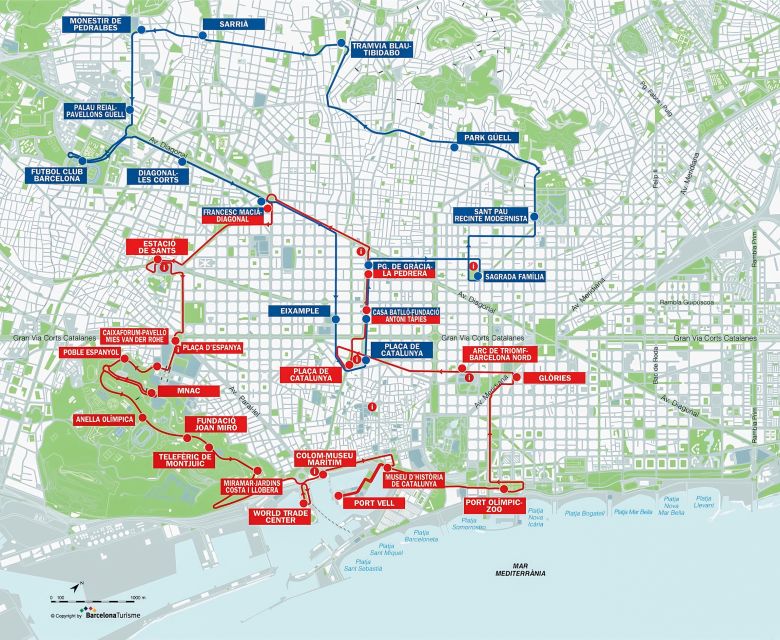
- Two routes cover very different Barcelona: The Red Route links the old center, Montjuïc, waterfront, beaches, Poblenou, and Sagrada Familia. The Blue Route heads toward Park Güell, Pedralbes, Sarrià, and FC Barcelona.
- The full loop takes about 120 minutes: That is useful for getting your bearings, but traffic and stop time can stretch the ride.
- A 24-hour ticket is not limited to one route: You can use both Red and Blue during the ticket period. A 48-hour ticket must be used on consecutive days.
- Park Güell requires extra effort: The bus stop is not directly at the park entrance, and the uphill walk can be difficult for some people.
- The last bus leaves Stop 1 at 7 p.m.: Do not assume the bus will carry you back after the final attraction stop.
- The upper deck gives the best views, but weather matters: It can be hot in summer, chilly in winter, and windy near the coast. The roof can close when rain begins.
Why this bus works well on a first day
Barcelona is spread across several distinct areas. The Gothic Quarter, Gaudí’s modernist buildings, Montjuïc, the beaches, Park Güell, and the football stadium are not all clustered together. The bus gives you a broad look at the city before you decide where to spend serious time.
I would use it early in your visit, not as a replacement for walking. Spend the morning on one route, get off at one or two major sights, then use the bus to understand how the neighborhoods fit together. You can return later by metro or on foot once you know which areas deserve more attention.
The open top is a real part of the experience. You get a clear view of façades, towers, parks, and city streets that can disappear behind a taxi window. The tradeoff is that the bus moves on its timetable. If you want a perfect photograph of a particular building, you may have only a few seconds.
The audio commentary adds useful context without turning the ride into a lecture. It is available in Spanish, Catalan, Chinese, English, French, German, Italian, Japanese, Portuguese, Russian, Dutch, Hebrew, Swedish, Arabic, Turkish, and Norwegian. Headphones are supplied, though you can bring your own.
More Hop-On Hop-Off Bus Tours in Spain
- Barcelona: 24 or 48-Hour Hop-On Hop-Off Bus Tour
★ 4.4 · 20,872 reviews - City Sightseeing Barcelona Hop-On Hop-Off Bus Tour: 24 or 48-Hour
★ 4.0 · 5,250 reviews - Barcelona City Tour Hop-On Hop-Off with Optional Boat
★ 4.0 · 3,012 reviews
The Red Route, from Plaça de Catalunya to the waterfront
The Red Route is the better choice if you want a broad look at central Barcelona, Montjuïc, the port, beaches, and the eastern side of the city. Its complete circuit takes about two hours, so choose your stops rather than trying to inspect everything.
The route begins at Plaça de Catalunya, a central starting point near La Rambla, Passeig de Gràcia, and the Gothic Quarter. From here, the bus passes Casa Batlló and Fundació Antoni Tàpies, giving you a quick look at one of Antoni Gaudí’s most playful façades and a nearby center for modern art.
The Eixample stop places you in the grid-shaped district created as Barcelona expanded beyond its medieval walls. It is a useful area for Gaudí architecture, cafés, and shopping, though the bus does not replace a proper walk along Passeig de Gràcia.
At Estació de Sants, the route reaches Barcelona’s major rail station. This is mainly useful as a transport connection rather than a sightseeing stop. Plaça d’Espanya is more rewarding, with its broad ceremonial space and access toward Montjuïc.
The CaixaForum and Mies van der Rohe Pavilion stop serves an important cluster of cultural buildings. The pavilion is a small but influential work of modern architecture, while CaixaForum hosts exhibitions. A short walk away, Poble Espanyol offers reconstructed Spanish regional architecture, craft shops, and places to eat. It is designed for tourism, so go for an easy cultural visit rather than an untouched neighborhood feel.
Next comes the Museu Nacional d’Art de Catalunya, set high on Montjuïc. The building itself is a major sight, and the hill gives you broad views toward the city. Nearby stops serve the Anella Olímpica, the Olympic ring, and the Fundació Joan Miró. Art fans should consider getting off here, but the hill means extra walking and time.
The Telefèric de Montjuïc stop is useful if you plan to ride the cable car. At Miramar and Jardins Costa i Llobera, you reach gardens and viewpoints above the port. These stops make Montjuïc worthwhile, but they are not quick add-ons. Allow enough time to walk and explore before catching another bus.
The Red Route then drops toward the World Trade Center and Colom, La Rambla. The Columbus Monument marks the lower end of La Rambla, the famous pedestrian boulevard lined with restaurants, shops, and street activity. From here, you can walk into the old city and reach the Gothic Quarter, the Picasso Museum, and nearby historic streets.
The Museu d’Història de Catalunya stop serves the waterfront museum and the Port Vell area. Port Olímpic gives access to the renovated marina and coastal promenade. Then come Platja del Bogatell and Platja Nova Mar Bella, useful choices if you want a beach break rather than another museum.
The eastern part of the route continues through Fòrum, Parc Diagonal Mar, and Poblenou. These areas show a newer side of Barcelona, with modern development, parks, former industrial districts, and beach access. They are less essential if you have only one day, but they help explain how the city has expanded.
At Torre Glòries, you see one of Barcelona’s most recognizable modern towers. The route then reaches Sagrada Familia, usually the most in-demand stop on the Red Route. The church is one of Gaudí’s defining works and remains under construction, so the exterior changes over time.
Give Sagrada Familia proper time if you plan to enter. The bus ticket does not include attraction admission, and a short hop-off stop is enough only for photographs from outside. Boarding can also be busy here, so allow for the possibility that you may need to wait for a later bus.
The final stop, Arc de Triomf, places you near the broad promenade leading toward Ciutadella Park and the old city. The route does not always make the monument feel obvious from the bus, but the stop is convenient for walking.
The Blue Route, Gaudí, Pedralbes, and football

The Blue Route is more focused on Gaudí, the upper parts of the city, elegant avenues, university districts, and FC Barcelona. It has fewer stops than the Red Route, but some of its most popular stops require time and uphill walking.
It begins at Plaça de Catalunya and Casa Batlló, then continues along Passeig de Gràcia to La Pedrera. La Pedrera, also called Casa Milà, is another major Gaudí building, known for its unusual stone façade and rooftop forms. Passeig de Gràcia is also one of the best places to see Barcelona’s modernist architecture in a concentrated area.
The Sant Pau Recinte Modernista stop serves the former hospital complex designed by Lluís Domènech i Montaner. Its buildings and tiled details offer a useful comparison with Gaudí’s work. If you like architecture, this may be one of the Blue Route’s best stops.
Park Güell is the headline stop. Gaudí’s colorful tiled work, curved forms, and hillside setting make it one of Barcelona’s signature sights. The practical problem is access: the bus stop is not directly at the entrance, and the walk is long and steep. If mobility is a concern, plan this stop carefully rather than treating it as a casual hop-off.
The next stop, Tramvia Blau and Tibidabo, points toward Barcelona’s upper slopes and the Tibidabo area. Sarrià offers a quieter neighborhood feel, while Monestir de Pedralbes serves the former monastery and its grounds. These stops are better for a slower half-day than for a rushed checklist.
At Palau Reial and Pavellons Güell, you can see more work connected with Gaudí and the royal palace area. FC Barcelona is essential for football fans, though the stadium attraction itself is not included in the bus ticket. If you do not plan to visit the stadium, this stop may feel like a long detour.
The Blue Route continues through Diagonal and Les Corts, Francesc Macià and Diagonal, Eixample, and Sant Antoni. These stops are useful for shopping, local streets, markets, and connections back toward the center. They are less important if your only goal is the major monuments, but they make the route practical for seeing more than the postcard version of Barcelona.
A useful strategy is to take the Blue Route first if Gaudí and Park Güell are high on your list, then use the Red Route for Montjuïc, the old center, and the waterfront. The reverse also works. Just remember that the routes are not short shuttle rides. Trying to make every stop can leave you seeing the city mostly through a bus window.
Timing, queues, and the 24-hour versus 48-hour ticket
Both routes begin at Stop 1 at 9 a.m., with the last departure from Stop 1 at 7 p.m. The published tour duration is 120 minutes. Buses are generally scheduled about every 20 minutes, while high-season service information says exclusive buses may run as often as every five minutes.
In practice, build in patience. Traffic, loading time, and crowded stops can affect the schedule. The buses usually come often enough for a relaxed day, but you should not use this service for a tight timed reservation unless you leave a generous margin.
A 24-hour ticket is more useful than the name may suggest. It runs for 24 hours from activation, so you can begin one afternoon, ride the Red Route, and use the Blue Route the following morning. That is a better plan than trying to complete both routes in one exhausting day.
A 48-hour ticket must be used on consecutive days. Choose it if you want to get off more often, visit major attractions, or use the bus as sightseeing transport rather than one long city loop.
More Sightseeing Bus Tours in Spain
- Seville: City Sightseeing Hop-On Hop-Off Bus Tour
★ 4.0 · 4,633 reviews - Palma de Mallorca: City Sightseeing Hop-On Hop-Off Bus Tour
★ 4.1 · 4,450 reviews - Madrid Panoramic City Bus Tour
★ 3.5 · 3,118 reviews - Malaga: City Sightseeing Hop-On Hop-Off Bus Tour
★ 4.0 · 2,619 reviews
Is $39 good value for Barcelona?
The price is $39 per person. I see the value mainly in the combination of transport and orientation, not in the bus ride alone.
If you complete both routes, make several stops, and use the audio guide, the ticket can save effort and simplify a short visit. It is particularly useful for families, older people, and anyone who wants to avoid long walks between widely separated sights. One family used the bus to keep a five-year-old moving with less walking, while another party found it helpful with a disabled passenger.
The value is weaker if you stay on for one loop and then walk everywhere. Barcelona’s metro is cheaper and often faster between central attractions. The bus also does not cover admission to Sagrada Familia, Park Güell, the Picasso Museum, the football attraction, or other paid sights.
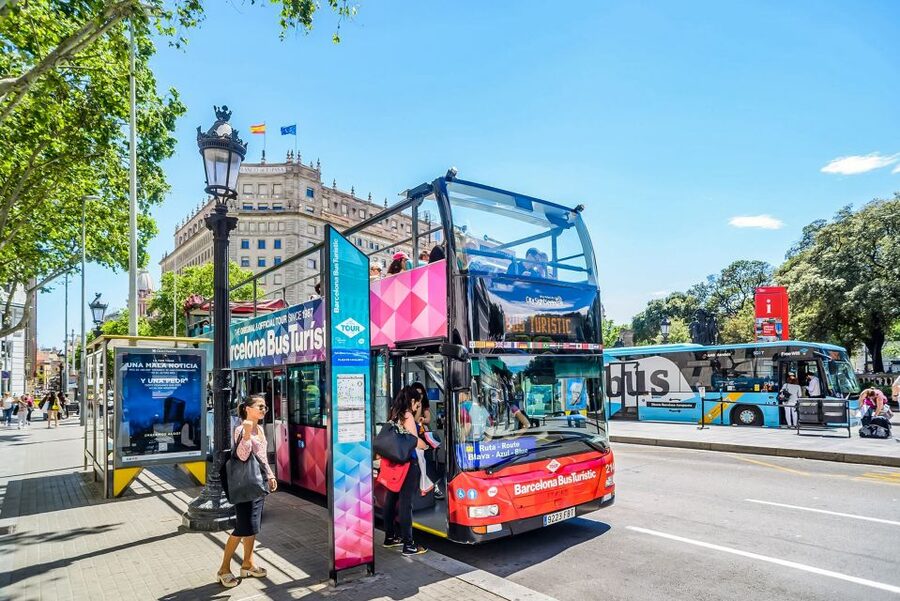
There is no hotel pickup, food, or drink. You board at a marked stop with a mobile or printed voucher. Buses are branded and labeled Barcelona Bus Turistic, even though the experience is provided by City Sightseeing Europe.
Comfort, weather, and small practical details
The buses are open-top double-deckers with free Wi-Fi, though the Wi-Fi may not work equally well on every bus. Bring water in hot weather, and consider sunscreen for the upper deck. Summer breezes can help, but the bus can still feel very hot.
In winter, the top deck can be chilly. When rain begins, the roof can close automatically, which helps keep the ride going. You can bring your own headphones, and that may be worthwhile if you want a more comfortable fit.
The buses are generally clean, and staff can be helpful at stops. Do not rush upstairs after boarding, though. At some stops, the bus may leave before you have found your preferred seat.
The service does not allow pets or smoking. It operates year-round except January 1 and December 25. One listed notice also says service is suspended on Thursday, February 12, so check the operating calendar for your exact date.
Who should book this Barcelona bus tour?
I would choose it for a first visit, a short stay, a family trip, or a day when you want to reduce walking. It is also a good fit if you want to see both the tourist center and outer districts such as Pedralbes, Sarrià, Poblenou, and Montjuïc.
It is less suitable if you already know Barcelona well, prefer public transport, or want an unhurried visit inside each attraction. The bus shows you the city, but it cannot replace walking through the Gothic Quarter, spending time inside the museums, or lingering at Gaudí’s buildings.
FAQ

How long does the Barcelona hop-on hop-off tour last?
A complete route takes about 120 minutes. You can stay on for the full loop or get off and board again during your 24 or 48-hour ticket period.
Can I use one ticket on both the Red and Blue Routes?
Yes. Your ticket gives access to both routes during its valid period.
What are the first and last departure times?
The first bus leaves Stop 1 at 9 a.m. The last bus leaves Stop 1 at 7 p.m. Do not assume a bus will return after 7 p.m. from every stop.
Is admission to Sagrada Familia or Park Güell included?
No. The bus ticket includes transportation, audio commentary, headphones, Wi-Fi, a city map, and a discount booklet, but attraction tickets are separate.
How often do the buses run?
The standard information lists buses about every 20 minutes. During high season, exclusive buses may run every five minutes, though traffic and crowding can still affect waiting time.
Is the audio guide available in English?
Yes. The audio guide is available in English, Spanish, Catalan, Chinese, French, German, Italian, Japanese, Portuguese, Russian, Dutch, Hebrew, Swedish, Arabic, Turkish, and Norwegian.
Should you book it?
Book this tour if you want an easy overview of Barcelona and plan to use both routes. I would start with it on your first full day, choose only a few major hop-off stops, and leave room for traffic.
The smartest choice for many short visits is the 24-hour ticket used across two calendar days. Choose 48 hours if you want slower sightseeing and more frequent stops. Skip it if you only need a quick ride between central sights, since the metro will usually cost less and save time.
More Sightseeing Bus Tours in Barcelona
- Rome: City Sightseeing Hop-on Hop-off Bus with Audioguide
★ 4.0 · 16,045 reviews - Rome: Big Bus Hop-on, Hop-off Open-Top Sightseeing Tour
★ 4.1 · 9,537 reviews - City Sightseeing London Hop-On Hop-Off Bus & Bookable Extras
★ 4.4 · 7,374 reviews - Hamburg: Line A Sightseeing Hop-On Hop-Off Bus Tour
★ 4.6 · 6,958 reviews
More Hop-On Hop-Off Bus Tours in Barcelona
- Barcelona: Hop-On Hop-Off Bus with Sailing Cruise
★ 4.3 · 412 reviews - Barcelona Hop-On Hop-Off Bus and FC Barcelona Immersive Tour
★ 4.2 · 362 reviews - Shore Excursion: Barcelona City Tour Hop-On Hop-Off
★ 4.0 · 280 reviews - Barcelona: Hop-On Hop-Off Bus & Aquarium Tour
★ 4.5 · 221 reviews
Just added around Barcelona
- Private Customized Barcelona Tour by Mercedes VIP Bus and Personal Expert Guide★ 5.0 · 4 reviews
- Barcelona City Hop On Hop Off and FC Barcelona Immersive Tour★ 3.5 · 10 reviews
- Barcelona Hop on Top City Tour★ 3.5 · 12 reviews
- Shore Excursion: Barcelona City Tour Hop-On Hop-Off★ 4.0 · 280 reviews
- Barcelona City Card with 30+Attractions, Tours and Hop on Hop off★ 4.5 · 9 reviews
- Barcelona City Tour Hop-On Hop-Off and Aquarium★ 4.5 · 6 reviews
- Barcelona: Hop-On Hop-Off Bus and Moco Museum Ticket★ 3.7 · 14 reviews
- Barcelona: Hop-On Hop-Off Bus & Aquarium Tour★ 4.5 · 221 reviews
Hop-On Hop-Off Bus Tours, compared.

City Sightseeing Hop-on Hop-off Bus with Audioguide
Read our review →
Tootbus Hop-on Hop-off (Optional River Cruise)
Read our review →
Big Bus Hop-On Hop-Off Tour with Optional Cruise
Read our review →
London Big Bus Hop-On Hop-Off Tour with Optional River Cruise
Read our review →
Big Bus Hop-on, Hop-off Open-Top Sightseeing Tour
Read our review →
City Sightseeing London Hop-On Hop-Off Bus & Bookable Extras
Read our review →Browse the lists this tour appears in