

Review · PERU
City Tour Panoramic Bus Departure from Larcomar
Lima rewards a guided first look. This four-hour tour links Larcomar and Miraflores with the colonial heart of the city, combining bus transport with a walking tour through the historic center. I like the easy route and the chance to see both a pre-Inca ceremonial site and the grand Plaza de Armas in one outing. The main drawback is traffic, which can make the return to Miraflores slow.
I also like the practical touches: WiFi, USB chargers, air conditioning, and entrance to Santo Domingo are included. Guides such as Bryan and Yoanna have earned praise for clear English, friendly service, and strong knowledge of Lima’s past. Still, check that you can hear the bus microphone, since poor sound quality has affected at least one outing.
Key points at a glance
- A useful four-hour introduction: You see Miraflores, Huaca Pucllana, and Lima’s historic center without arranging several separate visits.
- The bus is mainly transport: The most meaningful explanation and sightseeing happen on foot in the center of Lima.
- Larcomar gives you a striking starting point: This cliff-top shopping complex appears to float above the Pacific edge of Miraflores.
- Huaca Pucllana adds pre-Inca Lima: The archaeological site gives the tour a much older beginning than the Spanish colonial buildings downtown.
- Guiding is a major strength: Bryan and Yoanna are specifically praised for friendly, clear, well-informed commentary.
- Traffic can eat into your time: The return from the center to Miraflores may take longer than expected.
Why this Lima tour works well for a first visit
At $35 per person, this is priced as an accessible city introduction rather than a private, slow-paced sightseeing day. You get air-conditioned transport, onboard WiFi, phone chargers, fees, a guide in central Lima, and admission to the Convent of Santo Domingo. That package has real value if you want orientation quickly and prefer not to piece together taxis, entry tickets, and a walking guide.
The route also has a sensible historical arc. You begin in modern Miraflores, pass a pre-Inca ceremonial center, and finish among the churches, palaces, and public buildings of colonial and republican Lima. I like that progression because it keeps the city from being reduced to only its Spanish architecture.
The format matters. The bus is largely a way to cover ground, while the central Lima portion is primarily a walking tour. If you expect to remain seated and watch the city through a window for four hours, this may not match your expectations. If you want transportation between districts followed by time on foot with a guide, it makes much more sense.
The experience receives a 4.8 rating from 97 reviews, with 95 percent recommending it. That strong result seems tied less to luxury than to the guides. English-speaking guides have been singled out for being friendly, informative, and easy to follow. Bryan is praised for making the tour engaging, while Yoanna is praised for an enjoyable and informative walk.
More Sightseeing Bus Tours in Peru:
- Cusco: Sightseeing Tour of the City on an Open-Top Bus
★ 4.0 · 481 reviews - Lima : City Tour by Panoramic Bus – Walking & Catacombs
★ 4.3 · 41 reviews - Lima : City tour 360° Panoramic bus – Sightseeing Tour
★ 4.0 · 15 reviews
Starting above the Pacific at Larcomar
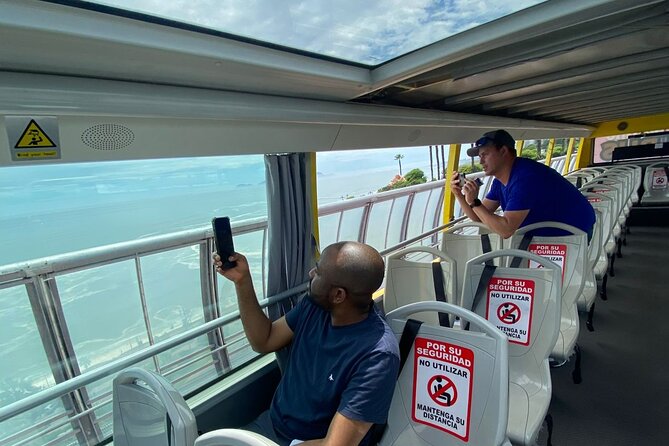
The meeting point is the Turibus location at Larcomar, on Malecón de la Reserva 610 in Miraflores. This is a convenient start for anyone already staying in Miraflores, and it gives you a look at one of Lima’s most recognizable modern developments before the historical portion begins.
Larcomar was built into an excavation at the top of the Lima cliff. Much of it sits above the void, creating the appearance of a complex suspended over the edge. The former Alfredo Salazar Park was reshaped into an artificial park, which also covers underground parking and cinema spaces.
Look for the bluish glass structures in the park. They are large ventilation chimneys for the underground areas, but they also function as modern sculpture. It is a small detail, yet it helps you read Larcomar as more than a shopping center. The site combines retail, public space, engineering, and the dramatic cliff setting that defines this part of Lima.
Larcomar is also a major tourist stop because of its location near hotels in Miraflores. I would arrive with enough time to find the Turibus meeting point without rushing. The supplied details do not include hotel pickup, and pickup service is specifically not included, so you need to reach Larcomar independently.
Huaca Pucllana and Lima before the Spanish conquest
The next major sight is the Pucllana Site Museum, home to a magnificent pre-Inca ceremonial center in Miraflores. This is one of the most useful stops on the route because it changes your sense of Lima’s age.
Many first-time visitors think of Lima through its Spanish cathedral, colonial balconies, and republican government buildings. Huaca Pucllana reminds you that organized ceremonial life existed here long before the city founded by Francisco Pizarro. The stop gives the tour a wider frame, moving beyond the better-known colonial center.
The information provided does not state how long you spend inside the museum or whether a separate admission is included for Pucllana. You should therefore treat it as a scheduled sight rather than assume a long, independent museum visit. The tour is designed to show you several parts of Lima in a limited time, so the guide’s explanation is likely important here.
For me, this is one of the route’s best choices. The contrast between modern Miraflores and an ancient ceremonial center is immediate. You are not simply seeing attractive buildings. You are seeing two very different stages of Lima’s development in the same district.
Walking into Plaza de Armas
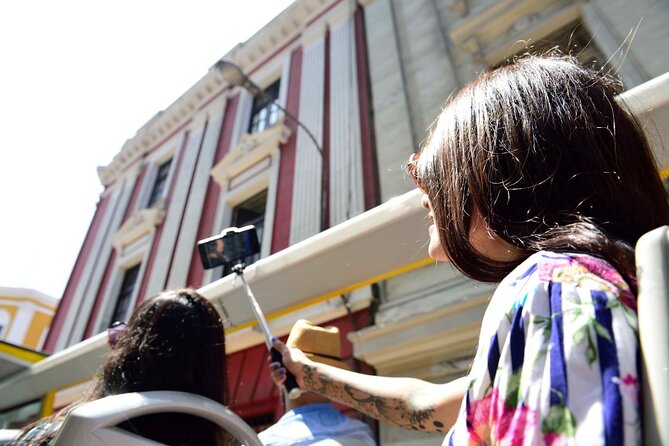
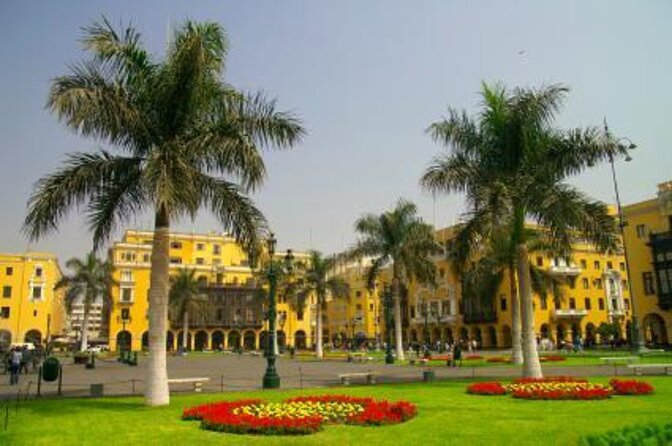
The historic center provides the tour’s main visual payoff. Lima’s Main Square, also called the Plaza de Armas or Plaza Mayor, is the foundational public space of the capital. The square is surrounded by the Government Palace, Lima Cathedral, the Church of the Sagrario, the Archbishop’s Palace, the Municipal Palace, and the Club de la Unión.
This is where the walking element matters most. The square is not just a place to take a photograph from the bus. Its buildings show the Spanish urban plan, with civic and religious power arranged around a central public space. The Municipality and Cathedral face each other, making the political and religious structure of colonial Lima easy to understand.
Several streets cross or border the square, including Jirón Junín, Jirón de la Unión, Jirón Huallaga, and Jirón Carabaya. The guide can help you understand how the square connects to the wider center rather than treating it as an isolated monument.
The architecture is formal and carefully framed, but do not expect a quiet European plaza. Lima is a working capital, and the center is part of an active city. The contrast between grand facades and heavy traffic is part of the experience. One tour member described the traffic as a nightmare, especially on the return to Miraflores, so keep your schedule flexible afterward.
More City Tours in Peru:
- Open Bus Cusco City Tour
★ 4.5 · 219 reviews - Cusco: Open-Top Bus City Tour
★ 4.4 · 64 reviews - Cusco: open-top bus city tour
★ 3.3 · 4 reviews - Lima: City Sightseeing Panoramic Bus Tour
★ 3.3 · 3 reviews
Jirón de la Unión and the Municipal Palace
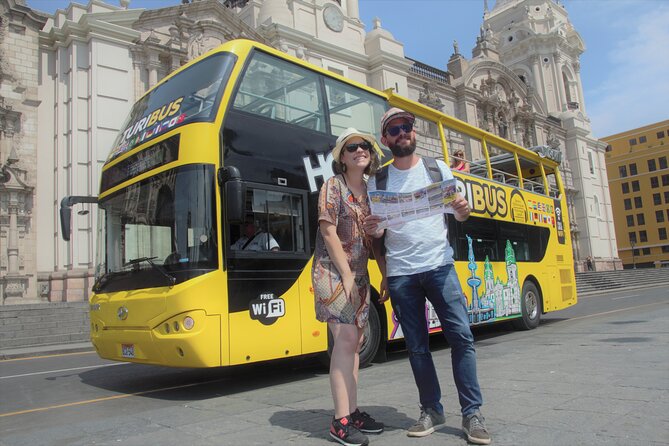
At Jirón de la Unión 300, you see the Municipal Palace of Lima, the main headquarters of the Metropolitan Municipality. It faces the Plaza de Armas from Portal de Escribanos Street, in the third block of Jirón de la Unión.
This stop helps explain how the historic center still functions as a seat of government. The building is not merely a preserved facade. It remains connected to the city’s administration, facing the same square that has anchored Lima’s public life for centuries.
The route also brings you close to the pedestrian and commercial character of Jirón de la Unión. The provided information does not promise a separate extended walk along the entire street, so think of this as part of the central Lima circuit rather than a full shopping excursion.
I appreciate this type of stop because it gives context to the square. A cathedral may be visually impressive, but the municipal building shows that the center is still a civic heart, not only a historic zone for photographs.
Lima Cathedral and the first years of the city
The Cathedral of Lima occupies a site with a complicated pre-colonial and colonial past. Before the cathedral, the location was associated with the Inca shrine of Puma Inti and the palace of Sinchi Puma, described as a descendant of the Inca Sinchi Roca.
When Pizarro founded Lima, he assigned the plot for a church. Sinchi Puma formally renounced his property through a notarized document, an act intended to prevent the seizure of the site from being treated as an unlawful occupation. In 1535, Pizarro laid the foundation stone and carried the first beam in public.
The first cathedral was completed in 1538 and inaugurated on March 11, 1540, under the dedication of Our Lady of the Assumption. That timeline gives you a useful reminder: Lima’s colonial center was built quickly as a symbol of Spanish power, but it also replaced earlier places and claims.
The cathedral is one of the tour’s essential stops because it connects architecture with political history. You are not only looking at a church. You are looking at the physical reshaping of an existing Inca setting.
Entrance to the Convent of Santo Domingo is included, although the supplied stop details do not explain exactly where it fits into the walking route. Ask your guide at the beginning when that visit will occur. That small question can help you understand how much free time you will have around the square.
Government Palace and the Casa de Pizarro

The Government Palace occupies the north side of the Plaza de Armas, beside the Rímac River. It is the main seat of Peru’s executive power and the official residence of the president. The complex contains about 19,208 square meters of built area.
Its location has carried political weight for nearly five centuries. The site was occupied by Francisco Pizarro in 1535 and may earlier have been associated with Taulichusco, a local leader connected to the Inca government in the Rímac Valley.
During the Spanish viceroyal period, the building was known as the Palace of the Viceroy and housed 40 viceroys of Peru. Later, José de San Martín and Simón Bolívar stayed there, along with most presidents of the republican era.
That makes the palace a strong final piece in the central Lima story. At Huaca Pucllana, you encounter pre-Inca ceremonial life. At the cathedral and palace, you see the arrival of Spanish rule and the continuing use of the center as a political stage.
The supplied information does not promise an interior visit to the Government Palace. Expect to see and hear about it from the square rather than assume you will enter.
How the bus and walking portions fit together
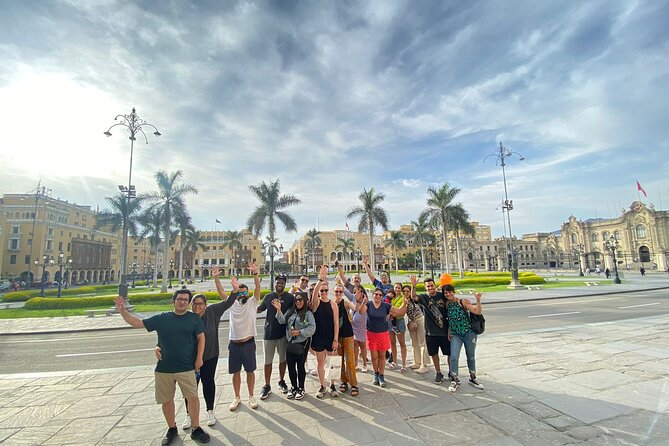
The four-hour duration is approximate. The bus gives you air-conditioned transport between Miraflores and central Lima, while the main interpretation takes place during the walking section. This arrangement is useful in a large city, especially if you want a guide to handle the route.
WiFi is available onboard, and USB chargers are provided at all seats. Those are practical touches, particularly if you are using your phone for photos, maps, or translation. Snacks are not included, so bring your own food if you need something during the half-day outing.
Sound quality deserves attention. One person found the bus microphone muffled and had trouble understanding the commentary. I would sit where you can hear clearly and tell the guide promptly if the audio is difficult. The walking guide may be easier to follow than the bus narration.
The tour is near public transportation, and most people can participate. Service animals are allowed. No group size is provided, so you should not assume a small-group or private format.
Who should book this $35 tour?
I would recommend it to you if this is your first time in Lima, your time is limited, or you want an efficient introduction before exploring on your own. It suits families, solo visitors, couples, and friends, with feedback from each of those types of customers. The mix of bus transport and walking also works well if you prefer not to manage Lima’s traffic yourself.
It is less suitable if you want a slow architectural study, long museum visits, or extensive free time at each stop. The tour covers a lot, and that means some sights will be viewed within a wider route rather than explored at length.
You should also leave room in your schedule after the tour. Traffic between the historic center and Miraflores can delay the return, and the exact timing is only approximate. Booking about 10 days ahead is sensible, since that is the average advance booking period.
Should you book the Larcomar city tour?
Book it if you want a well-priced overview of Lima that joins modern Miraflores, pre-Inca Pucllana, and the colonial center in one half-day. The strongest reason to choose it is the guiding. Bryan and Yoanna are praised for friendly, clear commentary, and the walking tour appears to be the heart of the outing.
Skip it if you dislike organized schedules or want every minute inside a monument. Also think twice if poor audio would frustrate you, since the bus microphone has not always been easy to hear. For most first-time visitors, though, $35 is a fair exchange for transportation, central Lima guiding, included fees, Santo Domingo admission, and a useful first map of the city.
FAQ
Where does the tour begin?
The meeting point is Turibus at Larcomar, Malecón de la Reserva 610, Miraflores 15074, Peru.
Is hotel pickup included?
No. Pickup is not included, so you must make your own way to the Larcomar meeting point.
How long does the tour last?
The tour lasts approximately four hours.
What is included in the price?
The price includes WiFi onboard, USB chargers, an air-conditioned vehicle, all fees and taxes, guiding in central Lima, and entrance to the Convent of Santo Domingo.
Are snacks included?
No. Snacks are not included.
Does the tour visit Huaca Pucllana?
Yes. The itinerary includes the Pucllana Site Museum, a pre-Inca ceremonial center in Miraflores.
Does the tour enter Lima Cathedral or the Government Palace?
The supplied tour details list these as stops but do not state that interior admission is included. The package specifically confirms entrance to the Convent of Santo Domingo.
Can I cancel for a full refund?
Yes. You can cancel at least 24 hours before the local start time for a full refund. Cancellations within 24 hours are not refunded, and changes within that period are not accepted.
What happens if bad weather cancels the tour?
If poor weather causes cancellation, you will be offered another date or a full refund.
Just added around Peru
- Machu Picchu Entry Ticket and Bus from Aguas Calientes★ 3.8 · 8 reviews
- Machu Picchu 2 Days / 1 Night (By Bus)★ 3.7 · 4 reviews
- LIMA WALKING TOUR CATACOMBS FROM MIRAFLORES, HISTORICAL CENTER, WINES+BUS★ 4.8 · 8 reviews
- Lima : City Tour by Panoramic Bus – Walking & Catacombs★ 4.3 · 41 reviews
- Lima: City Sightseeing Panoramic Bus Tour★ 3.3 · 3 reviews
- Lima : City tour 360° Panoramic bus – Sightseeing Tour★ 4.0 · 15 reviews
- From Lima : 360° Panoramic Bus★ 4.0 · 3 reviews
- From Cusco: Full-Day Touristic Bus to Puno with Guided Tours★ 5.0 · 3 reviews
Sightseeing Bus Tours, compared.
City Sightseeing Hop-on Hop-off Bus with Audioguide
Read our review →

Big Bus Hop-on, Hop-off Open-Top Sightseeing Tour
Read our review →
City Sightseeing London Hop-On Hop-Off Bus & Bookable Extras
Read our review →
City Sightseeing HOHO Bus Tour + Sunset & Night Tour
Read our review →
City Sightseeing Hop-On Hop-Off Bus with Audio Guide
Read our review →Browse the lists this tour appears in