
Review · JAPAN
Departing from Takayama [Regular sightseeing bus] World Heritage Sites Shirakawago and Gokayama Ainokura
Old Japan still feels close here. This 7-hour-20-minute bus tour from Takayama links two UNESCO-listed mountain villages that are awkward to reach on your own. I like the quiet first stop at Ainokura and the generous free time in Shirakawago. The main catch is simple: this is primarily transport with helpful commentary, not a fully guided walking tour.
I also like the comfortable air-conditioned bus and the way the route handles a full day without making you change vehicles. Guides explain village layouts, local customs, food, dialect, and practical walking routes before you arrive. Still, Shirakawago can feel rushed if you want lunch, the open-air museum, village streets, and the famous viewpoint all in one visit.
Key points to know before booking
![Departing from Takayama [Regular sightseeing bus] World Heritage Sites Shirakawago and Gokayama Ainokura - Key points to know before booking](https://assets.bustourdays.com/wp-content/uploads/departing-from-takayama-regular-sightseeing-bus-world-heritage-sites-shirakawago-and-gokayama-ainokura-1.jpg)
- Two very different Gassho villages: Ainokura is small and quiet, while Shirakawago is larger, busier, and better supplied with restaurants and shops.
- The guide works mainly on the bus: You receive useful explanations, maps, and suggestions, then explore independently at each stop.
- The schedule includes a famous viewpoint: Tenshukakau Observatory offers the classic elevated view of Shirakawago and its steep thatched roofs.
- Lunch is not included: You have time to eat at Shirakawago, but the meal cost is yours and restaurant queues can reduce sightseeing time.
- The open-air museum is included: Gassho-zukuri Minkaen gives you a closer look at traditional houses and village life.
- The ¥10,000 price needs a value check: At about $64.80 per person, you pay for easy transport, planning, commentary, and access, but a cheaper direct booking may be possible at the Nohi Bus Center.
Why these mountain villages are worth the long ride
![Departing from Takayama [Regular sightseeing bus] World Heritage Sites Shirakawago and Gokayama Ainokura - Why these mountain villages are worth the long ride](https://assets.bustourdays.com/wp-content/uploads/departing-from-takayama-regular-sightseeing-bus-world-heritage-sites-shirakawago-and-gokayama-ainokura-2.jpg)
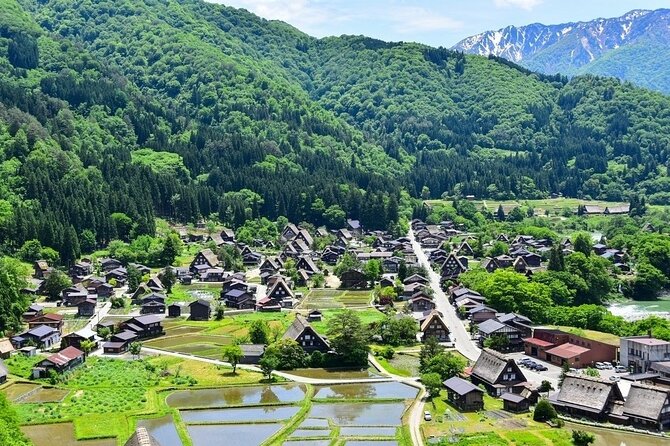
The attraction here is not one grand building. It is the complete setting: steep roofs, wooded hills, narrow roads, and old farmhouses grouped in valleys where heavy snow shaped every part of village life.
Gassho-zukuri means houses built in a praying-hands style. The sharply angled thatched roofs help snow slide away during the severe winters of this region. You do not need a long lecture to understand the design. One look at the roofs and the surrounding mountains makes the reason clear.
The two villages also give you a useful contrast. Ainokura has around 20 surviving Gassho-zukuri houses and feels compact. Shirakawago has 114 thatched houses and draws far more attention. Seeing the smaller community first is smart because it lets you appreciate the quiet rural character before arriving at the larger destination.
The bus matters more than it may seem. These villages are difficult to reach without planning, and winter road conditions can make independent driving a poor choice for some visitors. A medium or large air-conditioned bus takes care of the long transfers while the guide points out local food, dialect words, seasonal details, and sights to look for.
The journey takes most of a day, but the stops are long enough to make the ride worthwhile. You are not simply stepping off the bus for a photograph and climbing back aboard.
More Sightseeing Bus Tours in Japan
- Tokyo: Open Top Panoramic Sightseeing Bus with Audio Guide
★ 3.8 · 254 reviews - Tokyo: Morning Sightseeing Bus Tour
★ 4.4 · 109 reviews - Tokyo: 60min Panoramic Open Top Bus Tour with Audio Guide
★ 4.0 · 40 reviews
Starting in Takayama at 8:30 in the morning
The meeting point is at 6-chōme-125 Hanasatomachi, at the Nohi Bus location in Takayama. The tour begins at 8:30 a.m. and returns to the same meeting point.
Allow a few extra minutes at the start to exchange your voucher for the actual bus ticket. This step has caused confusion for some people, even though the process itself is described as easy. Do not arrive at the last second with your phone open and luggage in hand.
This is a shared sightseeing bus, not a private excursion. The bus may be medium or large, and the application allows a maximum of four people at one time. The stated experience information also notes a maximum of four participants, so confirm the current booking details if your group is larger.
The guide provides information in Japanese and English when needed. On some departures, the English-speaking group may receive commentary only in English. Guides such as Yamashia and Ikuichinami have been singled out for clear explanations, good organization, and useful recommendations.
You should think of the guide as a practical escort on the road, not someone who walks every street with you. That arrangement suits independent explorers. You get context before arriving, then choose your own pace.
Ainokura: a quiet first look at Gokayama
![Departing from Takayama [Regular sightseeing bus] World Heritage Sites Shirakawago and Gokayama Ainokura - Ainokura: a quiet first look at Gokayama](https://assets.bustourdays.com/wp-content/uploads/departing-from-takayama-regular-sightseeing-bus-world-heritage-sites-shirakawago-and-gokayama-ainokura-4.jpg)
Ainokura receives about 50 minutes. Admission to the village is free.
This is the calmer stop, and that is exactly why it works so well at the beginning. The village contains about 20 Gassho-zukuri houses, set against a wooded mountain setting. You can cross much of the settlement on foot in roughly five minutes, so the short visit is enough for a first look.
The village feels more closely tied to the surrounding mountain than Shirakawago does. The small scale lets you focus on the shape of the houses, the relationship between the buildings, and the old rural character rather than on a packed list of attractions.
Use your time here for a slow walk and photographs. Listen to the guide’s explanation before setting off, then follow the map and suggestions. You may find that Ainokura is the place where the traditional village idea becomes clearest, even though Shirakawago is the more famous name.
The drawback is the short stay. Fifty minutes does not allow much time for lingering inside several buildings or making a detailed visit. If you want every museum and side path, this tour will not provide that depth. For most people, though, the stop is well judged because it introduces the area without exhausting you before the main visit.
Shirakawago: two hours for the main event
The visit to the Historic Villages of Shirakawa-go lasts about two hours, with free admission to the village itself.
Shirakawago is larger than Ainokura and much more popular. Its Ogimachi settlement retains a remarkable group of thatched Gassho-zukuri houses, with 114 houses noted in the tour information. The scene is especially striking after fresh snow, when the roofs look almost toy-like against the mountains.
You have time to walk, browse shops, find lunch, and visit selected sights. The guide explains the village layout and suggests routes, but you are free to make your own plan. That is good news if you dislike being marched from one stop to another.
Two hours can feel generous at first, but it disappears quickly. A meal in a busy restaurant may involve a queue. Add photography, walking across the settlement, and a museum visit, and you may need to make choices.
Some people use this stop for lunch and the streets. Others skip a full sit-down meal, bring food, or eat quickly so they can reach the viewpoint. There is no included lunch, so you should decide before arrival which matters most to you.
I would prioritize the village itself and the viewpoint if this is your first visit. The streets give you the atmosphere, while the observatory provides the view that explains the village’s shape. Shops and cafés are useful extras, but they should not quietly consume the entire stop.
Same place, a different way to ride:
- Mt Fuji and Hakone 1-Day Bus Tour Return by Bullet Train
★ 5.0 · 26,383 reviews - 1-Day Tokyo Bus Tour
★ 5.0 · 14,250 reviews - PERFECT KYOTO 1-Day Bus Tour
★ 5.0 · 13,518 reviews - Peaceful Hiroshima & Miyajima UNESCO 1 Day Bus Tour
★ 5.0 · 5,309 reviews
Gassho-zukuri Minkaen: the included open-air museum
During the Shirakawago visit, the schedule includes about 30 minutes at Shirakawago Gassho-zukuri Minkaen. The entrance fee is included.
The open-air museum gives you a chance to enter and examine traditional Gassho buildings more closely. This is different from simply looking at roofs from the road. You can get a better sense of the house interiors, construction, and the way these buildings supported everyday life.
Thirty minutes is enough for a purposeful visit, but not for every building at a leisurely pace. One useful strategy is to listen carefully to the guide’s directions, select the houses that interest you most, and keep an eye on the meeting time.
The museum closes on Thursdays from December through March. If it is closed, the tour provides an original mascot instead. That is not an equal replacement for entry, so check the date if the museum is important to you.
The museum also creates a scheduling choice. You may prefer more time in the open-air collection, while another person in your group may want to walk the village or reach the viewpoint. The tour gives you access, but not enough time to do absolutely everything in detail.
Tenshukakau Observatory and the classic Shirakawago view
![Departing from Takayama [Regular sightseeing bus] World Heritage Sites Shirakawago and Gokayama Ainokura - Tenshukakau Observatory and the classic Shirakawago view](https://assets.bustourdays.com/wp-content/uploads/departing-from-takayama-regular-sightseeing-bus-world-heritage-sites-shirakawago-and-gokayama-ainokura-5.jpg)
The observatory stop lasts around 20 minutes and sits on a hill northwest of Shirakawago.
This is the picture-postcard stop. From above, the Gassho houses form a clear pattern across the valley, with their steep roofs lined up below the surrounding mountains. The elevated view helps you understand why Shirakawago is so memorable. From street level, individual buildings attract your attention. From the hill, the whole settlement makes sense.
Twenty minutes is brief, so go directly to the viewing area and take your photographs first. If you spend too long browsing elsewhere, you may miss the main reason for the stop.
The observatory also creates one of the tour’s biggest time pressures. A queue for lunch can force you to choose between the viewpoint and the museum. If you want all three, move efficiently and avoid assuming that a three-hour stop, as described in some scheduling details, means three relaxed hours for every attraction. The detailed stop timing lists two hours for Shirakawago, 30 minutes for the museum, and 20 minutes for the observatory, so follow the guide’s exact instructions on the day.
What the guide adds, and what the guide does not do
The strongest part of the service is the information given before each stop. The guide explains the village layout, points out where to eat, suggests walking routes, and shares details about Hida foods, seasonal conditions, and local dialect.
That preparation makes independent sightseeing easier. You arrive with a map, a basic plan, and a better idea of what deserves your time. Several guides have been praised for speaking clearly without burying the group under facts. That is the right approach for a day with limited hours.
The guide does not normally lead a continuous walking tour through every village. Once you get off the bus, you generally explore on your own and return at the required time. If you want a historian beside you for every building, this will feel light on guiding.
I see that as a fair trade for this route. The villages are best enjoyed with some freedom. You can stop for a photograph, enter a house, eat lunch, or simply walk without trying to keep up with a group.
Bus comfort, scenery, and seasonal conditions
![Departing from Takayama [Regular sightseeing bus] World Heritage Sites Shirakawago and Gokayama Ainokura - Bus comfort, scenery, and seasonal conditions](https://assets.bustourdays.com/wp-content/uploads/departing-from-takayama-regular-sightseeing-bus-world-heritage-sites-shirakawago-and-gokayama-ainokura-6.jpg)
The air-conditioned bus provides a major practical benefit. The route involves mountain roads and a fair amount of driving, so a comfortable seat is more valuable here than on a short city tour.
The views from the road are part of the experience. You pass through the Japanese Alps and see the countryside change with the seasons. Snow gives the villages a storybook appearance, while autumn brings a different mood and color. A first snowfall has been especially memorable for people taking this trip.
Weather can affect the operation. The experience requires good conditions, and a cancellation caused by poor weather may result in another date or a full refund. You should dress for outdoor walking and expect colder conditions in the mountain villages than in central Takayama, especially in winter.
The driver is another quiet strength of the arrangement. Careful driving matters on mountain roads, and the bus removes the stress of navigation, parking, and winter driving from your day.
Is $64.80 a fair price?
At about $64.80 per person, the price is reasonable if you value time and simplicity. You receive round-trip bus transport from Takayama, a bilingual bus guide, admission to Gassho-zukuri Minkaen, and a planned route to two UNESCO-listed settlements.
Lunch is not included, and neither are personal purchases. You are paying mainly for reliable transport and organization rather than a private guide or a luxury meal.
There is one important price question. A direct Nohi Bus booking at the bus center may cost around 8,000 yen, according to one detailed assessment. That means an online reseller may charge more for advance booking and convenience. Compare the direct price before paying if your dates are flexible.
The value improves in winter, on crowded days, or whenever you would rather not arrange separate transport. It is less attractive if you are comfortable handling buses yourself and want to stay longer in one village.
Small details that make the day run better
- Exchange your voucher at the Nohi Bus location before departure, and allow extra time for it.
- Keep the guide’s map with you. It helps you find lunch, the walking routes, and the meeting area.
- Decide your priority at Shirakawago before arriving: village streets, lunch, the museum, or the observatory.
- Do not assume you can fit every attraction into the stop, especially if restaurants are busy.
- Bring your own lunch only if you are comfortable eating on your own schedule. One person used this approach to avoid losing time in a restaurant queue.
- Check the museum closure if you are visiting on a Thursday between December and March.
- Follow the return time carefully. The bus waits for the group, but a late return can disrupt the entire route.
- Check the final charge if you book through a reseller, since one booking produced a higher card charge than expected.
Who should book this day trip?
I would choose this tour if you are based in Takayama and want to see both Ainokura and Shirakawago without building a transport plan. It suits first-time visitors, independent sightseers, couples, families, and anyone who wants clear instructions but not a rigid walking group.
It is also a strong option in winter, when driving may be less appealing and the villages look their best under snow. The air-conditioned bus and careful route planning remove much of the strain from a long mountain day.
I would look elsewhere if you want a slow village stay, extended museum visits, or a fully guided cultural tour. The schedule is fixed, the main Shirakawago stop can feel short, and the guide’s role is mainly to prepare you rather than accompany you through every lane.
The experience is rated 4.7 out of 5, with 92 percent recommending it. That fits the actual offer: strong transport, good organization, useful commentary, and attractive stops, balanced by limited time and the need to manage lunch wisely.
Should you book the Ainokura and Shirakawago bus tour?
Book it if you want an efficient, well-organized day from Takayama and accept that free time will be self-directed. The combination of quiet Ainokura, larger Shirakawago, the open-air museum, and the hilltop view gives you a solid introduction to this distinctive part of Japan.
Before paying, compare the direct Nohi Bus price and check the meeting instructions. If you do book, arrive early, exchange your voucher, plan your Shirakawago priorities, and treat the guide’s advice as your time-saving tool. For most people, that is enough to turn a difficult independent excursion into a comfortable and rewarding day.
FAQ
Where does the tour start and finish?
It starts at 6-chōme-125 Hanasatomachi, Takayama, Gifu 506-0026, Japan, at the Nohi Bus location. It returns to the same meeting point.
What time does the bus leave?
The scheduled departure time is 8:30 a.m.
How long does the experience last?
The full experience lasts approximately 7 hours and 20 minutes.
Is lunch included?
No. Lunch is not included, but you have time to eat at Shirakawago.
Is the Gassho-zukuri Minkaen admission included?
Yes. Admission is included when the open-air museum is operating.
Is the tour guided throughout the villages?
The Nohi Bus guide provides information on the bus, maps, and suggestions for each stop. You generally explore the villages independently after getting off the bus.
What happens if the museum is closed?
Gassho-zukuri Minkaen is closed on Thursdays from December through March. If it is closed, an original tour mascot is provided instead.
Can I cancel for a full refund?
Yes, if you cancel at least 24 hours before the local start time. Cancellations or changes made less than 24 hours before departure are not refunded or accepted.
What happens if poor weather cancels the tour?
You will be offered another date or a full refund if the experience is canceled because of poor weather.
More History Tours in Japan
- [One-day bus tour departing from Kanazawa Station] Shirakawa-go and Gokayama – Two World Heritage Villages Enjoyable Bus Tour
★ 5.0 · 253 reviews - From Kyoto: Nara History Guided Half Day Bus Tour with Lunch
★ 4.8 · 114 reviews - [Day trip bus tour from Kanazawa Station] Weekend only! World Heritage Shirakawago Day Bus Tour
★ 5.0 · 46 reviews - From Kyoto: Nara History Guided Half Day Bus Tour with lunch
★ 5.0 · 23 reviews
Just added around Japan
- Kyoto Sagano Romantic Train in Arashiyama Bus Tour★ 3.0 · 6 reviews
- NARUTO & BORUTO at Nijigen no Mori Park Entry& Bus Transportation★ 3.0 · 3 reviews
- From Kyoto: Nara History Guided Half Day Bus Tour with lunch★ 5.0 · 23 reviews
- Kyoto 1 Day Golden Route Bus Tour★ 5.0 · 15 reviews
- Kyoto Hop-On, Hop-Off Sightseeing Bus Tour★ 3.0 · 5 reviews
- Amanohashidate & Miyama 1-Day Bus Tour: From Osaka/Kyoto w/ Lunch★ 4.5 · 18 reviews
- Full Day Hiroshima and Miyajima Bus Tour★ 5.0 · 12 reviews
- Hiroshima, Miyajima 1 Day Bus with Indian Lunch from Osaka, Kyoto★ 5.0 · 7 reviews
Sightseeing Bus Tours, compared.
City Sightseeing Hop-on Hop-off Bus with Audioguide
Read our review →

Big Bus Hop-on, Hop-off Open-Top Sightseeing Tour
Read our review →
City Sightseeing London Hop-On Hop-Off Bus & Bookable Extras
Read our review →

City Sightseeing HOHO Bus Tour + Sunset & Night Tour
Read our review →
City Sightseeing Hop-On Hop-Off Bus with Audio Guide
Read our review →Browse the lists this tour appears in