
Review · FRANCE
Visit Avignon and Villeneuve lez Avignon aboard a Double-Decker Bus
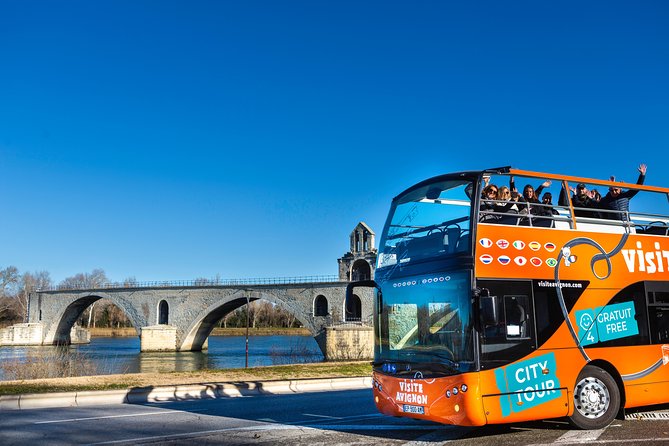
Avignon looks best from above. This double-decker bus connects the papal city with Villeneuve lez Avignon, crossing the Rhône and reaching sights you might skip on foot. I like the broad introduction to the area and the useful view from Île de la Barthelasse. The main catch is that this is not always a classic hop-on hop-off service, and some departures appear to operate more like a single sightseeing loop.
I also like the low price, about $16.30 per person, and the chance to see both sides of the Rhône without arranging separate transport. The drawbacks are real: the audio system may not work at every seat, the bus can move too quickly for good photographs, and operating days and meeting points need careful checking before you go.
Key points to know before boarding
- The route crosses two sides of the Rhône, linking Avignon with Villeneuve lez Avignon and Île de la Barthelasse.
- Pont Saint-Bénézet admission is not included, so the bus gives you useful context but does not cover entry.
- The tour may be one loop rather than flexible hop-on hop-off service, depending on the day and operation.
- Audio commentary is supplied in English, although equipment has not always worked at every seat.
- Fort Saint-André and its gardens are major highlights, with free admission listed for the stop itself.
- Check the schedule carefully, especially for Sundays, Mondays, the 1pm to 2pm lunch break, and the precise departure point at 40 Cours Jean Jaurès.
What this Avignon bus tour is really for
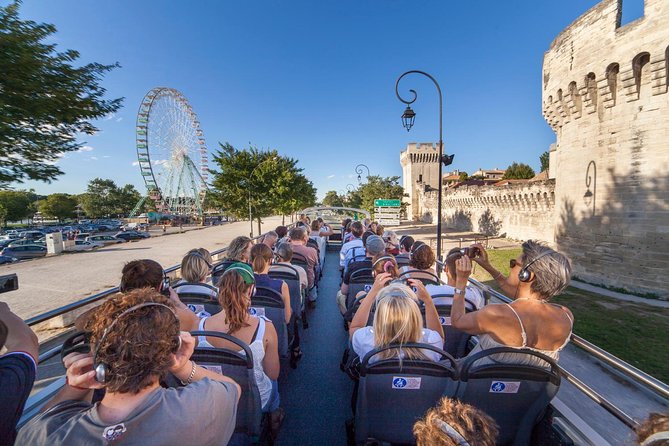
Avignon is compact inside its medieval walls, but its story reaches across the Rhône. The papal palace, the broken bridge, the royal tower in Villeneuve, and the green island between the two banks all belong to one connected story. This bus tour is useful because it lets you see that larger picture without spending the day on foot.
The bus begins at 40 Cours Jean Jaurès and returns there. The published duration is unusually broad, from about one hour to a full day. That range suggests two possible ways to use it: take one complete circuit for an overview, or use it as a hop-on hop-off service if the day’s timetable and bus operation allow.
I would not book this expecting a tightly managed guided excursion with a guide beside you. The main commentary is audio, and the experience depends on the bus route, the working headset system, and your ability to get off at the right stop. Some departures have reportedly functioned more as a one-hour drive around the outskirts than as a flexible sightseeing pass.
That difference matters. If you want a quick orientation, the route can be excellent. If you want to spend an hour at Fort Saint-André, reboard, and continue to the next attraction with no uncertainty, confirm the practical details first.
More Open-Top Bus Tours in France
- Paris: Big Bus Panoramic Night Tour by Open-Top Bus
★ 4.4 · 4,168 reviews - Ajaccio: Town Highlights and Coast Open-Top Bus Tour
★ 4.3 · 1,523 reviews - Paris: Tootbus Open-Top Christmas Bus Tour
★ 4.0 · 1,365 reviews
Pont Saint-Bénézet and the song that made it famous
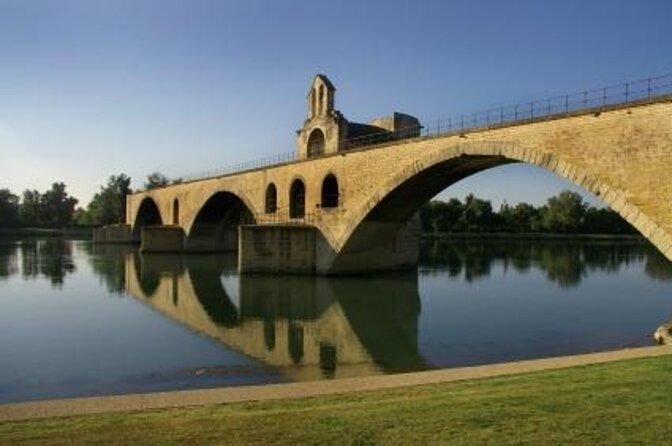
The first major sight is Pont Saint-Bénézet, better known as Pont d’Avignon. You probably know the name from the old song about dancing on the bridge. The surviving section makes the song feel slightly mischievous, since the bridge no longer reaches across the Rhône.
Construction began in 1177. The original bridge measured about 920 meters, had 22 arches, and was roughly four meters wide. It was completed in eight years, an impressive feat for the period. The first Romanesque bridge was destroyed during the siege of 1226, then rebuilt on a similar scale.
The bridge once carried pilgrims between Italy and Spain. Later, it became essential to the papal court in Avignon. Cardinals built residences in Villeneuve lez Avignon to escape the crowded and unhealthy city across the river, while the Popes stayed within Avignon’s walls. The bridge became the direct link between these religious and political centers.
At each crossing, Popes reportedly paused near the Bénezet chapel to pray and leave a florin. The bridge was paved in 1377 after repeated slips caused accidents and drownings. Louis XIV was among the last rulers to cross before the bridge fell into its present ruined condition in the seventeenth century.
The bus does not include admission to the bridge. That is important when you work out the total cost. You can see the bridge from the bus and from the riverbanks, but entering the monument requires a separate ticket.
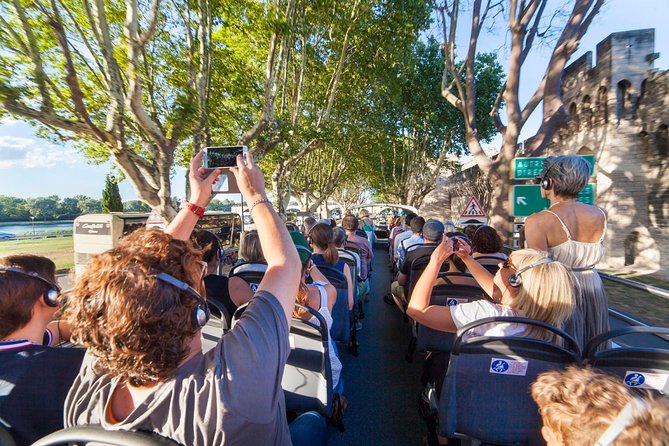
For photographs, the bus can be frustrating. It moves through traffic, and the upper deck gives you a good angle only when the vehicle slows or stops. I would treat the ride as an introduction, then return to the bridge on foot if it becomes one of your main interests.
The Lambert Collection, modern art in an old mansion
The route also passes the Lambert Collection, Avignon’s museum of modern art. Its location is part of the appeal: the collection occupies an eighteenth-century mansion rather than a purpose-built modern gallery.
Gallerist and collector Yvon Lambert opened the collection in June 2000 during Avignon’s year as European Capital of Culture. The first donation included about 350 works from the 1960s to the present, and the collection later grew to more than 1,200 references.
The museum covers about 2,000 square meters and includes exhibitions, conservation work, programs for young people, a bookstore, artists’ editions, and a restaurant in the courtyard. That makes it more than a quick picture stop. If you enjoy modern art, you could easily plan extra time here.
The bus ride only gives you the orientation. Admission is not identified as included, so budget separately if you plan to enter. If art is not your priority, you can still appreciate the contrast between this contemporary collection and Avignon’s medieval walls and papal buildings.
Philippe le Bel Tower and the royal side of the river
On the Villeneuve side, the Philippe le Bel Tower recalls a different kind of power. King Philippe le Bel ordered the tower in the thirteenth century to control access to Pont d’Avignon.
It is a clear example of medieval military architecture, but its meaning goes beyond stone walls. The tower represented royal authority facing papal authority across the Rhône. In Avignon, the Popes controlled one side of the crossing. In Villeneuve, the French Crown made sure the bridge could be watched and regulated.
This is one reason the bus route is worthwhile. Walking around Avignon’s center, you can understand the papal city very well, but it is harder to grasp the political tension between the two banks. The tower gives that story a physical shape.
The information supplied for this stop does not state a separate admission price or visit length. Treat it as a sight along the route unless the driver confirms that the bus stops long enough for entry.
Same place, a different way to ride:
- Paris: Tootbus Hop-on Hop-off (Optional River Cruise)
★ 4.3 · 15,279 reviews - Paris: Big Bus Hop-On Hop-Off Tour with Optional Cruise
★ 4.4 · 13,279 reviews - Paris Big Bus Hop-On Hop-Off Tour with Optional River Cruise
★ 4.0 · 6,534 reviews - Paris Seine River Hop-On Hop-Off Sightseeing Cruise by Batobus
★ 4.0 · 3,411 reviews
Fort Saint-André and the Abbey gardens
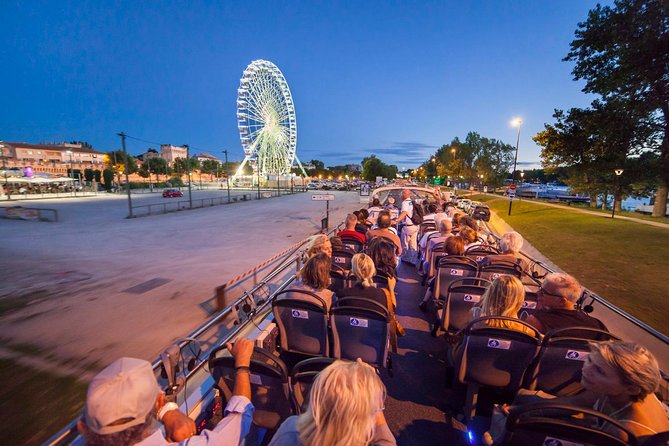
Fort Saint-André is one of the most appealing stops on the Villeneuve side. Construction began at the end of the twelfth century, and the fort later defended the Benedictine abbey of the same name during the fourteenth century.
The fort offers more than a military wall. The Abbey of Saint-André is known for its gardens, which carry the Remarkable Gardens label. Inside and around the abbey, you can find vaulted rooms decorated in the seventeenth century, Romanesque remains, Renaissance Tuscan-style details, rose beds, and Mediterranean plants.
Admission to Fort Saint-André is listed as free, which improves the value of the bus ticket. Still, the bus itself may not give you a long visit. One listed stop allows about an hour, but the experience can vary if the vehicle is running as a loop or if you choose to remain aboard.
I would plan this stop carefully. If the gardens are your reason for crossing the Rhône, ask before boarding how long the bus will wait and when the next service returns. A missed bus can turn a simple stop into a long wait, particularly if the route is operating less often than expected.
Chartreuse de Villeneuve lez Avignon
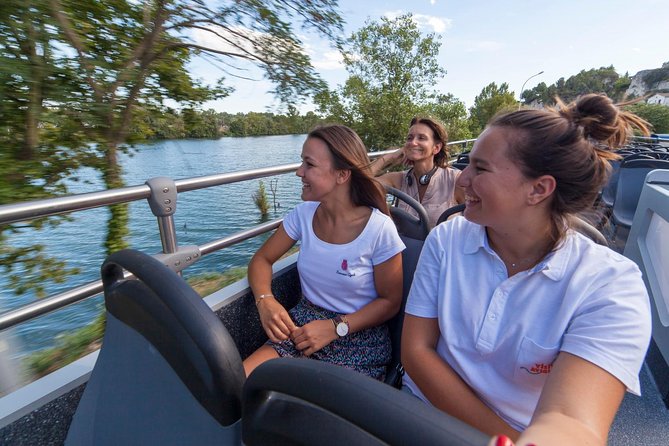
The Chartreuse of the Val de Bénédiction is another major Villeneuve sight. This former cardinal’s residence was built from 1353 under the direction of Pope Innocent VI.
The complex occupies a mansion dating from the fourteenth century, a place associated with several cardinals. Its presence reinforces the unusual character of Villeneuve: this was not simply a suburb across the river, but a place where senior church figures created their own residences away from Avignon.
Admission is not included. As with Pont Saint-Bénézet, the bus provides the geographical link and the outside view, while entry requires its own ticket.
The Chartreuse is best suited to you if you want more than a quick city overview. It asks for time and attention, especially when combined with Fort Saint-André and the abbey gardens. Trying to visit every paid attraction during a short loop would make the day rushed.
Île de la Barthelasse and the best wide view
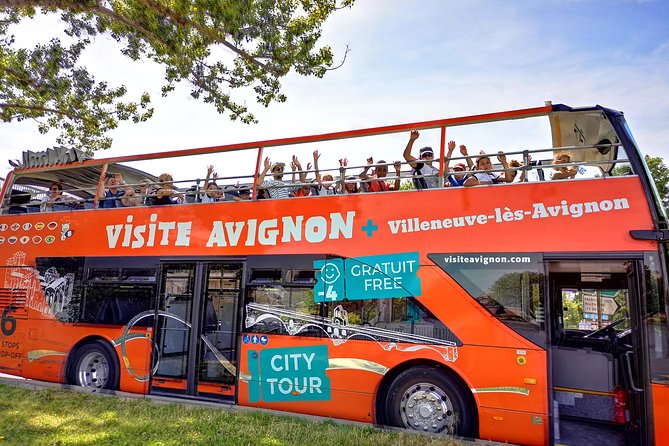
The final major part of the route reaches Île de la Barthelasse, a 700-hectare green area in the Rhône. The bus makes a stop of about 10 to 15 minutes, giving you time to pause and look back toward Avignon.
This is one of the most useful stops because the view changes the way you understand the city. From the island, you see the papal city across the water rather than from inside its walls. The towers, ramparts, and river sit together in one broad view.
The stop is also a practical break. You can relax, continue by bicycle, or use the free river shuttle to reach the historic center. The shuttle option is especially useful if you want to avoid retracing part of the bus route, although the supplied details do not give its operating timetable.
Do not expect a long island visit from the bus itself. Ten to 15 minutes is enough for a look and a few photographs, not a full exploration of the island. If the bus is moving quickly elsewhere, this may be the place where you most appreciate having your camera ready.
Audio, seating, and the pace of the ride
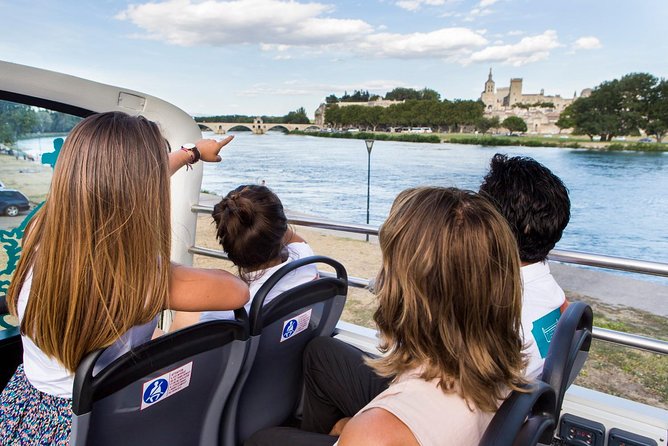
The bus uses audio commentary in English. That is helpful for understanding what you are seeing, especially when the vehicle crosses the Rhône and circles the outer parts of the city.
The audio system is also the weak point. At least one account found that several upper-deck connections did not work, leaving passengers unsure what they were passing. The operator indicated that the driver could provide replacement audio equipment, so report a faulty connection immediately rather than accepting a silent ride.
The vehicle is a standard double-decker bus, and one account described it as clean and high quality. A smaller articulated bus may also operate for an inner-city tour, but that is presented as a separate add-on rather than the same experience.
Traffic can take up much of the one-hour circuit. One account estimated that about 30 minutes of a short tour was spent in traffic. That is not necessarily wasted time, since the route is designed to show the wider area, but it does reduce the time available for stops and photographs.
The upper deck gives you better views, while the lower deck may be more practical if the weather turns poor. This experience requires good weather, and a cancellation for poor conditions should result in a choice of another date or a full refund.
Price, timing, and the question of value
At about $16.30 per person, the bus is inexpensive for a city orientation. The price makes sense if you use it to see Avignon from outside the walls, cross to Villeneuve, reach the island, and decide which places deserve a longer visit.
The value falls if you only complete a rushed one-hour loop in traffic. The tour does not include entry to Pont Saint-Bénézet or the Chartreuse, and the available information does not show admission to the Lambert Collection as included. You are paying mainly for transport, the route, and the commentary.
The advertised duration of one hour to one day is another reason to ask questions at the start. It suggests that a full-day use may be possible, but the experience is not always described as a reliable hop-on hop-off service. Several practical problems have been reported: a stop shown in the wrong place, difficulty returning to the original starting point, and a midday driver break from 1pm to 2pm.
Operating days also need checking. Service was unavailable on some Sundays and Mondays in May 2024, and the booking system had accepted at least one Sunday reservation despite that closure. Policies can change, so confirm the current operating day and departure time directly before you set out.
The maximum group size is 73 people. That is a substantial bus, not a small personal tour. It can feel efficient for city transport, but it will not offer the intimacy or flexibility of a private guide.
Who should book this experience?
I would recommend the bus to you if you want a first look at Avignon and Villeneuve, have limited mobility for long walks, or want to understand the relationship between the two sides of the Rhône. It is also useful early in a stay, before choosing which sights deserve separate admission tickets.
The route suits families and independent visitors who like audio commentary and the freedom to decide how much time to spend at each place. Service animals are allowed, and most people can participate.
I would be more cautious if you have only one day in Avignon and need guaranteed timing. I would also think twice if your main goal is a detailed visit to the bridge, Fort Saint-André, the Chartreuse, and the modern art museum. The bus can connect those places, but it cannot replace time inside them.
FAQ
Where does the bus tour start?
The tour starts at 40 Cours Jean Jaurès, 84000 Avignon, France.
Where does the tour finish?
The activity returns to the original meeting point.
How long does the experience last?
The published duration ranges from about one hour to one day. A short circuit can take about one hour, while a hop-on hop-off use may take longer.
Is the tour offered in English?
Yes. English audio commentary is available.
Is Pont Saint-Bénézet admission included?
No. Admission to Pont Saint-Bénézet is not included in the tour price.
Is admission to the Chartreuse de Villeneuve lez Avignon included?
No. Admission to the Chartreuse is not included.
Is admission to Fort Saint-André free?
The supplied tour details list admission to Fort Saint-André as free.
Does the bus stop at Île de la Barthelasse?
Yes. The stop lasts about 10 to 15 minutes and provides views toward Avignon. You can also use the free river shuttle from the island.
Are service animals allowed?
Yes. Service animals are allowed.
Can I cancel for a full refund?
Yes, if you cancel at least 24 hours before the experience starts. Cancellations made less than 24 hours before the start time are not refunded. If poor weather or insufficient bookings cancel the experience, you should be offered another date or a full refund.
Should you book the Avignon double-decker bus?
Book it if you want a low-cost orientation that reaches both Avignon and Villeneuve lez Avignon. The Pont d’Avignon story, Philippe le Bel Tower, Fort Saint-André, Chartreuse, and Île de la Barthelasse make this more useful than a simple drive around the old city.
Just treat it as an introduction, not a guaranteed all-day sightseeing system. Confirm the meeting point, operating day, lunch break, return arrangements, and whether the bus will wait at the stops. Used that way, the $16.30 price can be good value. If you need a fully flexible hop-on hop-off service, a slower walking tour, or guaranteed access to every attraction, choose another plan or use this bus only for your first circuit.
Just added around France
- Private Tour of Epernay and Vineyards by Bus with Champagne★ 5.0 · 7 reviews
- Épernay and Champagne Open-Top Bus Tour with 3 Tastings★ 5.0 · 11 reviews
- Explore Cannes Countryside in Style with our Classic Bus Tours!★ 5.0 · 2 reviews
- City Tour in Cannes aboard our Classic French Bus!★ 5.0 · 109 reviews
- Visit of Antibes Juan-Les-Pins by convertible bus★ 3.5 · 24 reviews
- Tour of Annecy by convertible bus★ 4.1 · 92 reviews
- Paris: Tootbus Kids Bus Tour Experience★ 4.7 · 30 reviews
- Paris: Bustronome Gourmet Lunch Tour on a Glass-Roof Bus★ 4.8 · 442 reviews
Open-Top & Double-Decker Bus Tours, compared.

Big Bus Hop-on, Hop-off Open-Top Sightseeing Tour
Read our review →
Hop-on Hop-off Sightseeing Tour by Open-top Bus
Read our review →
London by Night Sightseeing Open-Top Bus Tour
Read our review →
Big Bus NYC: Hop-On Hop-Off Sightseeing Tour by Open-top Bus
Read our review →


Hop-on Hop-off Sightseeing Tour by Open-top Bus with 18 Stops
Read our review →
Big Bus Las Vegas: Sightseeing Night Tour by Open-Top Bus
Read our review →Browse the lists this tour appears in